
Exposed Aggregate Concrete in Naperville, IL
A textured stone surface that grips under wet shoes and hides wear. It has to be planned before the pour, because the finish is made in the few hours after the concrete is placed.
Get Your Free Estimate
Tell us where the slab goes and what stone you like. We respond within 24 hours.
Exposed Aggregate Concrete Is Decided Before the Truck Arrives
Walk across exposed aggregate and you feel it before you see it: a firm, bumpy field of stone tips under your shoes, where a regular slab is flat paste. From the street it reads as a speckled, earthy texture. Up close it is stone set in concrete, and the stone does the work. It gives a wet shoe something to catch, and it hides tire marks and wear that show on a plain gray drive.
You will hear it called several things. Exposed aggregate and aggregate concrete are the same finish. Washed concrete, pebble finish, and washed stone describe how it looks or how it is made. All of them mean concrete whose top layer of cement paste was removed while the slab was green, so the aggregate underneath shows.
The catch is timing. Every other choice on a concrete job can be argued about until pour day. This one cannot. The stone has to be in the mix or on the jobsite, the retarder has to be on the truck, and the crew has to know how deep to wash before the first yard comes down the chute. A few hours after the pour, the window is gone for good.
Settle these before pour day
- Which stone showsThe standard rock in the mix, or a decorative stone ordered for the job. That changes what gets batched at the plant.
- How deep to expose itA light, medium, or heavy reveal. That sets which retarder goes on, or when the crew starts washing.
- Where the stone stopsThe whole slab, or a field with a smooth or broomed border. Borders are formed and finished differently, so they have to be planned before the pour.
- Who walks on it barefootA pool surround or a back patio for kids points to a smaller, rounder stone. A driveway can take a coarser one.
How Exposed Aggregate Is Made: Retarder, Washing, and Seeded Stone
Mix-Exposed vs. Seeded Aggregate
There are two ways to get stone to the surface. In a mix-exposed slab, the stone you see is the stone in the concrete, either the standard rock or a decorative aggregate batched in at the plant. It runs through the full depth, so wear only uncovers more of the same. In a seeded slab, a decorative stone is spread over the fresh concrete and pressed in, so a smaller amount of premium stone covers the surface. Seeding gives more control over stone density and color; a mix-exposed slab is simpler and consistent all the way down. Which one makes sense depends on the stone you want and how much of it the job needs.
Surface Retarder or a Timed Wash
The older method is to wait and wash: the crew watches the slab and starts scrubbing off the cream when the concrete has set enough to hold the stone but not so much that the paste has hardened. On a hot, windy day that window can be short, and on a big slab one end can be ready while the other is not. A surface retarder takes most of the guesswork out. Sprayed on after finishing, it slows the set of only the top layer, so the slab cures underneath while the cream stays soft enough to wash off hours later, sometimes the next morning. Retarders are graded by how deep they work, which is how the depth of the reveal gets chosen ahead of time.
Light, Medium, and Heavy Exposure
Light
Sand and the tops of the stone show. Smoothest underfoot and the most subtle look.
Medium
The stone is clearly visible and textured. The usual choice for walks, patios, and drives.
Heavy
Stone stands out boldly. Most dramatic, roughest to walk on, and less paste holding each stone.
Deeper is not better. Each stone has to stay buried well past its middle to stay locked in, so a heavy reveal on a small stone is how you end up with loose pebbles.
What Happens on Pour Day
Place and Strike Off
The concrete is placed, struck off to grade, and bull floated like any other slab. If the job calls for a decorative stone that is not in the mix, it is broadcast across the wet surface at this point and pressed in until the cement paste covers it.
Finish, Then Stop the Surface From Setting
Edges and joints are tooled, and the surface is left smooth. Then the paste on top has to be kept workable while the slab underneath sets: a surface retarder is sprayed on, or the crew watches the slab and waits for the right moment to wash.
Wash Off the Cream
With water and a soft broom, the thin layer of cement paste (the cream) is scrubbed away to uncover the stone. Too early and stones loosen and wash out. Too late and the paste has hardened over them and will not come off evenly. This is the step that makes or breaks the finish.
Rinse and Cure
The surface is rinsed until the haze is gone and then cured like any new slab. Control joints are tooled during finishing or saw cut once the concrete can take the blade.
Protect the Paste
After the concrete has cured, a sealer protects the paste between the stones from water and salt. On surfaces that get wet, a non-slip additive goes into the sealer.
Aggregate Concrete Stone Choices: River Rock, Granite, and Quartz
Even with no upgrade, an exposed finish shows whatever rock the plant batches into a standard mix. It is the plainest look and the least expensive. For more control, a decorative aggregate can be specified.
- River rock and pebble
- Rounded, water-worn stone in mixed earth tones. Smooth edges make it the most comfortable under bare feet, which is why it is the usual pick around pools.
- Granite
- Hard stone, usually crushed, so the pieces are angular. Holds up well under tires and gives a crisp, salt-and-pepper or reddish look depending on the source. Sharper underfoot than river rock.
- Quartz
- Light-colored stone with a slight sparkle in sun. Used to brighten the surface or as an accent seeded into a darker field.
Two rules hold for every stone. Smaller and rounder is kinder to feet, knees, and shovels; larger and angular is bolder and rougher. And photos lie about color, because wet stone, dry stone, and sealed stone all look different. That is why we bring samples to the free consultation, so you can see and feel them on your own property.
Exposed Aggregate Driveway in Naperville: Salt, Plows, and Shovels
A driveway is where this finish earns its price or fails. The stone is the hardest part of the concrete and it shrugs off tires. The weak point is the paste between the stones. Water soaks into it, freezes, and expands through every Naperville winter, and salt brine dripping off wheel wells keeps it wet and attacks it. Once that paste erodes, stones lose their grip.
The defense starts with the mix. Concrete that will see freeze-thaw needs entrained air, tiny bubbles that give freezing water room to expand. Next door, Lisle's permit guides require it for exactly that reason. After that it comes down to a reveal that leaves each stone well embedded, a sealer that keeps brine out of the paste, and no rock salt on the new surface its first winter; use sand for traction instead.
Plows and shovels. The surface is as strong as any concrete driveway, but the texture changes how snow comes off. A steel blade rides on the stone tips and leaves a film behind, and it can catch and chip stone at slab edges. A plastic or rubber-edged blade is gentler, and if a plow service clears your drive, ask them to keep the blade slightly raised.
The street end. Where the drive meets the street, it crosses the public right-of-way, and towns treat a finish other than plain concrete there differently. In Oswego, for example, anything other than standard concrete or asphalt in the driveway approach requires a notarized Encroachment License recorded with the Kendall County Recorder, on top of the building permit. Rules differ by town, so we confirm what Naperville requires for your address before the pour. Our Naperville driveway permit guide covers when a permit applies. Some owners keep the street end in a plain broom finish and start the stone at the property line.
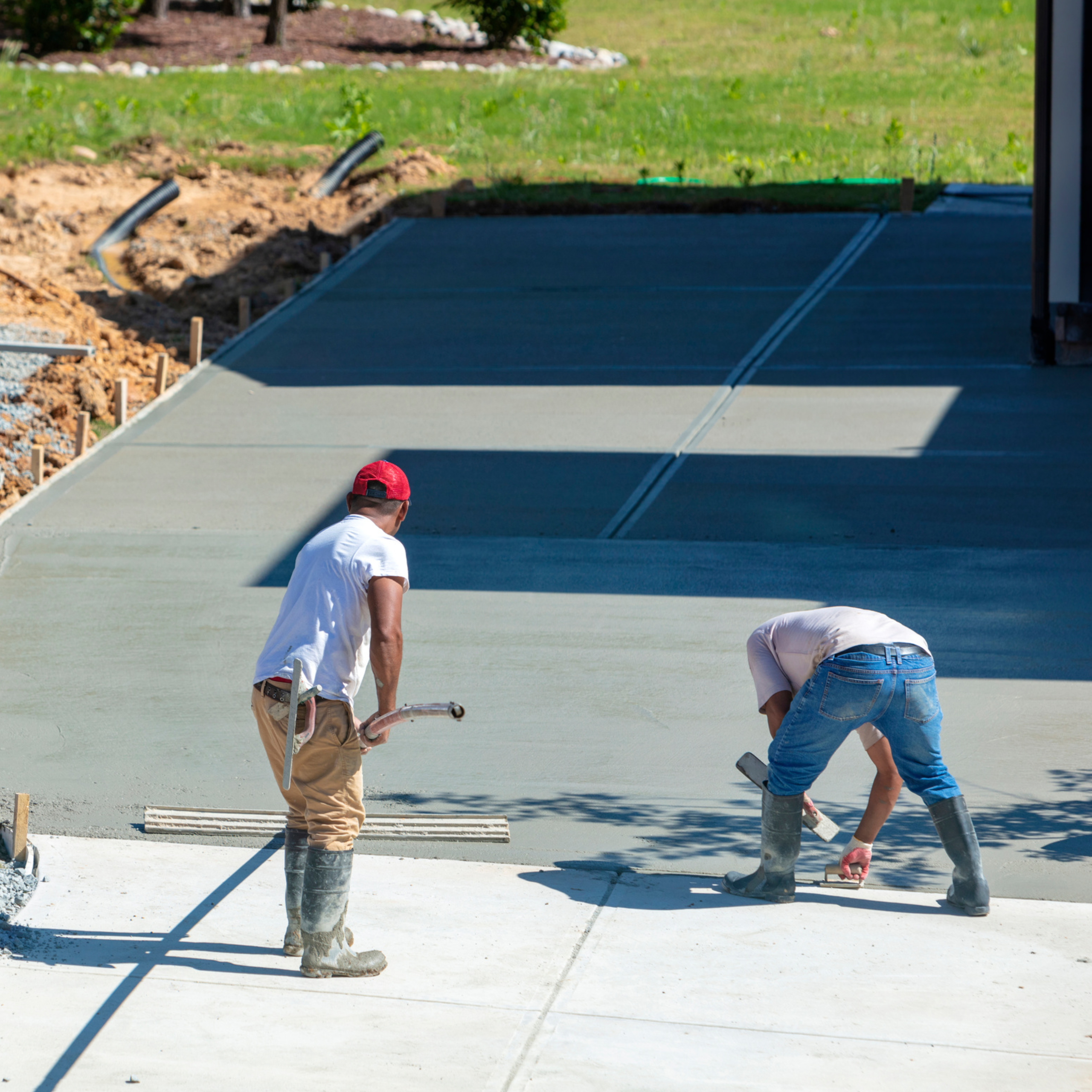
Base, thickness, and joints follow the same rules as any of our concrete driveways; the exposed finish goes on top of a properly built slab, not in place of one.
Exposed Aggregate for Patios, Walkways, and Pool Surrounds
Patios
A pebble field hides leaf stains and grill drips that show on a smooth slab, and it does not glare in afternoon sun. The tradeoff is furniture: chair legs can rock on a heavy reveal, and a texture this busy is harder to sweep. A medium reveal with a smooth or broomed border under the table area is a common compromise. See our concrete patios page for layout and base.
Walkways
A front walk takes slush, rain, and every guest, and an exposed finish holds a wet shoe well. Many owners match the walk to the driveway so the two read as one surface. Keep wheeled traffic in mind: strollers, carts, and walkers roll rougher on a heavy reveal. More on layout and base on our concrete walkways page.
Pool Surrounds and Bare Feet
Wet, bare feet are where grip matters most, and the stone gives it without relying on a coating. To be straight about it: coarse or crushed stone can be rough on bare feet and on kids who sit on the edge. A small, rounded pebble at a light to medium reveal is gentler, and a non-slip additive in the sealer keeps a sealed surface from turning slick. Our concrete pool decks page covers drainage and coping.
Exposed Aggregate Problems Worth Knowing Before You Choose It
It cannot be added to concrete you already have.
The wash has to happen while the slab is setting. If your current slab is sound and you just want it to look better, an exposed finish is the most expensive way to get there, because the old concrete has to come out first. A resurfacing overlay or a stain costs less. An overlay is a thin cement layer with its own textures, not real exposed stone, but for a lot of people it is the better buy, and we will say so even though the new pour is the bigger job for us.
Wash timing is the most common failure.
Washed too early, stones loosen and the surface looks pitted. Washed too late, the paste stays on in blotches and the stone looks muddy. Neither can be fixed afterward without replacement. A surface retarder widens the window, which is why it is worth asking any crew how they plan to time the wash.
Some stones will pop.
A few loose stones along edges and joints early on is normal. Bare patches across the field are not; they point to a reveal too deep for the stone size, or paste worn away by salt.
Patches show.
Matching the stone, paste color, and reveal on a small area is close to impossible. Utility cuts and damaged sections usually get replaced back to the joint lines instead of patched.
It is rougher to sweep and shovel.
Leaves, grit, and snow hang in the texture. A stiff broom and a leaf blower handle most of it, and the plastic-edged shovel matters more here than on a broomed slab.
Most of the long-term care comes down to keeping water and salt out of the paste. Our concrete sealing guide covers which sealer to use on a textured surface, and why a high-gloss film can turn a grippy finish slick.
Exposed Aggregate Concrete Cost in Naperville
These are the same ranges published across our site. The finish runs $10 to $18 per square foot, and a full exposed aggregate driveway or patio runs $12 to $18 per square foot installed, including all prep work.
Naperville Exposed Aggregate Pricing
| Item | Low Range | High Range | Notes |
|---|---|---|---|
| Exposed aggregate (per sq ft) | $10 | $18 | New pour required |
| Exposed aggregate driveway or patio, installed | $12 | $18/sq ft | Includes all prep work |
Prices reflect Naperville, IL area averages. Exposed aggregate requires a new pour. We provide exact quotes after an on-site evaluation.
The stone
Standard mix rock costs the least. A decorative stone ordered in the mix, or seeded by hand onto the surface, adds material and labor.
Tear-out
Exposed aggregate is new concrete. If an old slab is in the way, removal and haul-away come first.
Borders and bands
A smooth or broomed frame around a pebble field takes extra forming and a second finishing method on the same pour.
Size and access
A small walk carries the same setup and washing crew as a larger patio, so small jobs land higher per square foot.
For how the finish compares with other options on a full project, see our driveway cost guide and patio cost guide.
Choosing Between a Pebble Finish and Other Surfaces
Most people choosing exposed aggregate are weighing it against a broom finish or stamped concrete. A broom finish is the most affordable and the easiest to live with. Stamping gives a pattern that imitates stone, brick, or wood. Exposed aggregate shows real stone. All three are decided before the pour, and all three can be combined on one job, such as a pebble field with a stamped or smooth border.
| Compared on | Exposed aggregate | Broom finish | Stamped |
|---|---|---|---|
| Feel underfoot | Bumpy; rounded stone is gentler than crushed | Fine, even grit | Smooth with pattern texture |
| Grip when wet | Strong, from the stone itself | Strong, from the broom lines | Depends on the sealer and additive |
| Shoveling | Blade rides on the stone; slower to scrape clean | Easiest | Grout lines catch a steel blade |
| Patching later | Hard to match the stone and depth | Easiest to blend | Hard to match color and pattern |
| Works on an existing slab | No, new pour only | No, new pour only | No, new pour only (overlays are a separate system) |
Our short answer: pick exposed aggregate when grip and a natural look matter more than a smooth surface, and the slab is going in new anyway. Pick broom when budget and easy snow clearing come first. For staining and coloring, see decorative concrete.
Exposed Aggregate FAQs
It is concrete finished so the stone inside it shows on the surface. While the slab is still green, the thin layer of cement paste on top is washed off, either after a surface retarder has kept it soft or by washing at exactly the right point in the set. What is left is a field of stone tips locked in concrete. People also call it aggregate concrete, washed concrete, or a pebble finish. The stone can be the standard rock in the mix or a decorative stone like river rock, granite, or quartz.
Not as a washed finish. The cream has to come off during the hours after the pour, while the concrete is still setting. Once a slab has hardened, the stone is locked under a cured paste. Getting an exposed aggregate look on an existing driveway or patio means replacing that section. If the slab is sound and you only want a new look, an overlay or a stain costs less than tearing it out.
The bare finish is one of the grippiest surfaces you can pour, because the stone itself gives your shoe something to catch. Sealer changes that. A glossy, film-forming sealer can fill the texture and make it slick, so on wet areas we add a non-slip additive to the sealer. No finish is safe on ice; the stone helps, but it does not replace salt or sand in a Naperville winter.
A few loose stones along edges and joints in the first months is normal. Widespread loss usually means the surface was washed too early or too deep, so the stones were not held by enough paste. Freeze-thaw and road salt eating into the paste between stones can loosen more over time, which is why the surface should be kept sealed. If large patches are bare, that is a pour-day problem, not a maintenance one.
Rarely. A patch has to match the stone, the color of the paste, and the depth of the reveal, and fresh concrete never weathers the same as the old slab around it. The cleanest fix for a damaged area is usually to replace it back to the nearest control joints, so the new section reads as its own panel.
Yes. The surface is as strong as any driveway concrete. The texture means a shovel or blade rides on the stone tips instead of scraping clean, so a thin film of snow can stay behind. A plastic or rubber-edged shovel and a snow blower with its scraper set slightly high are easier on the stone and on you.
Planning a new slab? Our Naperville concrete contractors will bring stone samples and walk the site with you.
Get an Exposed Aggregate Estimate in Naperville
Tell us what you are pouring and roughly how big it is. We will bring stone samples and tell you honestly whether the finish fits how you use the space.