
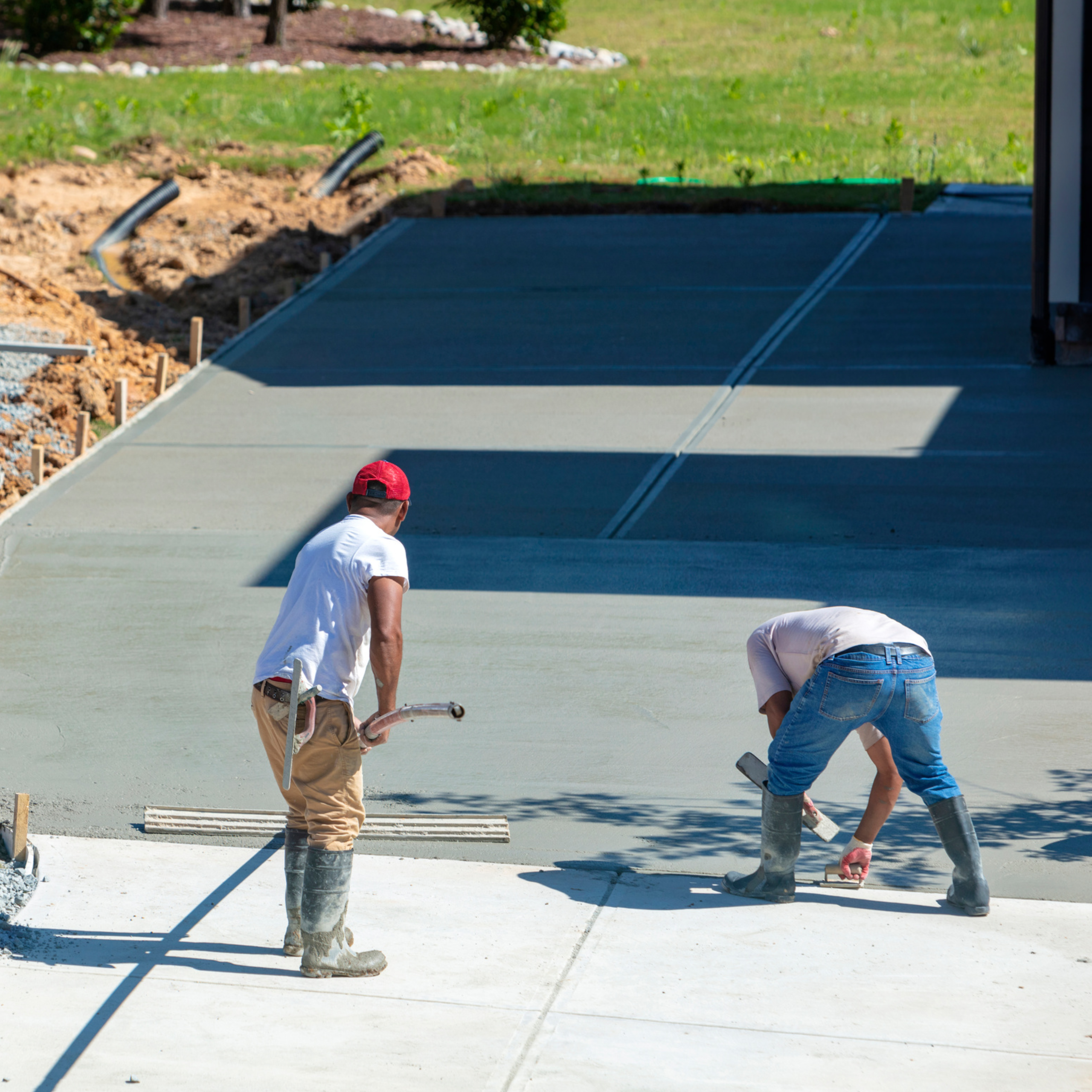
Concrete Replacement for Oswego's Boom-Year Subdivisions
Driveway, patio, and slab replacement for the village's boom-era homes.
Nearly every slab in Oswego's subdivisions went in during the same building run, so the village's concrete is not just aging, it is aging in unison, subdivision by subdivision. If your driveway went in when the house was built, odds are it is now 20 to 35 years old, and so are most of the slabs on Oswego's newer streets.
Naperville Concrete Construction takes on that work as concrete contractors based in Naperville, with Oswego a straight run to the southwest. The village marks the far edge of our service area, and the drive is worth making now: the replacement wave is arriving one street at a time.
What the boom years poured, how builder-grade concrete behaves at this age, what the Kendall County permit counter requires, and what honest replacement numbers look like all fit below. None of it needs a sales visit to understand, and all of it can end in a written quote.
How Oswego Grew Into Kendall County's Largest Town
Census Numbers That Explain Your Driveway's Age
The village grew from 3,875 residents in 1990 to 30,355 at the 2010 count, nearly eight times over. Kendall County rode the same wave hard enough to be named the fastest-growing county in the United States for the 2000-2010 decade, and Oswego, the county's largest town, sat at the center of it.
Growth like Oswego's gets poured, not just framed. Every rooftop added between those counts came with a driveway, a garage floor, service walks, a stoop, and often a patio. When a town grows nearly eightfold inside two decades, the concrete underneath it lands in one narrow age band.
The sprint has since settled into steady growth, but the inventory remains: subdivision after subdivision of Oswego flatwork placed on a production schedule through the building boom, all of it reaching the same stretch of its service life together.
A River Town Core, Then Everything Else
Oswego is older than its subdivisions suggest. Settlers arrived in 1833, and the blocks near the Fox River still carry that early footprint. Concrete there behaves like old-town concrete anywhere: mixed ages, mature tree roots, walks and drives replaced piecemeal across generations.
Cross out of Oswego's river grid and the story flips. The community went from a compact Fox River settlement to Kendall County's growth engine, and the square miles around the old grid are almost entirely production-built, with flatwork poured by whichever subcontractor the builder had signed that season.
So the first question on any Oswego estimate is the year the house was built. On the old grid, slab and house rarely match ages, and each panel needs its own read. In the subdivisions, the pour date is the build date, and that one fact predicts most of what we find.
Why Builder-Grade Pours Age on a Deadline
Production concrete is not bad concrete, but it is minimum concrete. Builders pouring dozens of Oswego driveways a month specified the thickness the code required, a base placed fast, and little or no reinforcement. That package performs fine early, then depends entirely on how well the ground beneath was compacted.
Past the two-decade mark the shortcuts surface. Control joints crack through and widen, winter salt scales the concrete, and panels settle wherever utility trenches were backfilled loose. Once water works under a slab edge, every freeze lifts it a little further out of plane, and patching stops holding.
The honest exception: plenty of boom-era pours around Oswego are still sound. A well-drained lot and a base that happened to get compacted properly can carry a slab decades past its cohort. When we see one, the advice is to keep it sealed and leave it alone, not to replace it.
Oswego Concrete Driveways, Patios, and Garage Slabs in Their Third Decade
Replacing a Driveway to a Better Spec Than the Original
Replacement is the moment to fix what the production schedule skipped. A rebuilt Oswego drive gets a compacted stone base checked before the pour, reinforcement suited to the loads, and joints cut where the slab wants to crack anyway. Our concrete driveways page walks through the full specification.
Across the Naperville area, broom-finish concrete runs from about $8 to around $12 per square foot, and a standard two-car replacement lands from roughly $3,200 to around $5,400, with larger drives running from about $5,400 to around $9,000, and oversized or decorative projects able to pass $12,000. Those figures hold in Oswego's subdivisions, where straight lot lines keep tear-out simple.
Timing is the quiet advantage. When whole Oswego streets share a pour date, they share a failure window, and replacements cluster. Booking early in the season beats calling after the neighbors have filled the calendar, and concrete replaced before its base fails costs less than the same slab replaced after.
Patios: Replace the Concrete, Upgrade the Plan
Oswego's boom-year patios were an afterthought: a small square of broom-finished concrete off the back door, sized to close a sale rather than fit the yard. When one of those slabs cracks and settles in its third decade, copying it square for square wastes the tear-out you are already paying for.
The repour is the cheap chance to get the patio the lot deserves: larger, regraded to shed water away from the foundation, and finished for how the yard actually gets used. Our concrete patios page lays out the options, from plain broom to full decorative work.
Across the Naperville area, a mid-size patio runs from about $2,400 to around $4,800 in broom finish, with decorative projects reaching $12,000, and stamped work prices from about $12 to around $22 per square foot. In Oswego's newer sections, a stamped border around a broom field is a sensible middle path.
Garage Slabs, Stoops, and the 42-Inch Rule
Oswego's amended building code is specific about what sits under new concrete. Slab-on-ground floors must be at least 4 inches thick, trench footings have to reach 42 inches below grade, and wood foundations are banned outright. Those rules shape every outbuilding quote.
Porches carry their own code requirement: anything wider or deeper than three feet needs a full-depth footing and foundation wall, not a pad floating on grade. Stoops are the practical parallel. A shallow pad poured on grade is exactly what frost heave moves, which is how a boom-era stoop ends up tipped away from its threshold.
Our concrete foundations and slabs page covers footing and slab options for Oswego garages, sheds, and additions. In a northern Illinois freeze-thaw climate, getting bearing depth right the first time is the difference between a slab that stays level and one that walks with the seasons.
Permits on the Kendall County Side of the Line
In This Village, Everything Gets a Permit
Homeowners arriving with DuPage County habits sometimes assume a patio or a service walk slips under the permit threshold. Not in Oswego. The village amends the residential code so that all work requires a permit, and it names patios, sidewalks, driveways, decks, and fences explicitly. There is no skipping the counter.
The code base is current: Oswego adopted the 2021 international building and residential codes effective October 2024, with local amendments layered on top. Inspectors check the compacted stone base before any concrete is placed, which is precisely the step the production builders rushed the first time around.
We prepare the drawings and carry the application through as part of the project, and we schedule work to the village's requirements. Both are handled inside the job on our side, and both belong in any quote you compare, because a lowball price that omits the permit is not a comparable price.
What the Village Fee Schedule Says
Oswego prices residential permit work by project cost, so the village's share stays modest next to the concrete itself. From the published schedule:
- •Permit fee: $0.92 per $100 of project cost, with a $46 minimum
- •Plan review: 15 percent of the permit fee, with a $50 minimum
- •Unpermitted work: the permit fee doubles once the village catches it
On a typical two-car driveway replacement, the permit fee itself starts at the $46 minimum, and either way Oswego's cut is small money against the pour itself. The doubled fee for skipping the permit erases any savings.
Concrete poured on a production schedule fails on a production schedule, and Oswego's boom-era flatwork is entering that window together. The practical move is a condition read before the base goes: seal it and wait, repair the failing panels, or replace while the job is still straightforward.
A call or text to (331) 261-5065with the build year and a photo of the worst panel is enough to start. If the slab has service life left, the estimate says keep it sealed and spend nothing. If it does not, the written quote puts your street on the schedule before Oswego's season fills.
Get Ahead of Oswego's Repour Wave
Tell us about your project and we'll get back to you within 24 hours.