Concrete Projects in Warrenville, Permitted and Poured Right
Permits filed, specs met, concrete poured on schedule.
Warrenville requires a building permit before residential concrete gets poured, and the rule is explicit: driveways, patios, and sidewalks appear by name on Warrenville's permit-required list, with stoops named separately in the fee ordinance. The residential driveway fee is $100 under that ordinance. Inspections are usually scheduled within two days of a request once a permit issues.
Naperville Concrete Construction files that permit as part of the driveway or patio job, not as an extra. Applications go in online with drawings attached, and city staff handle the review start to finish through a fully electronic process. You approve a written quote first, then the paperwork moves without a trip to City Hall.
The permit path sets the pour date more than the weather does. Warrenville's quick inspection turnarounds mean work moves fast once concrete is ordered. Planning the review window up front keeps a project on track from application to closed-out permit, so an approved job rarely sits waiting.
What Warrenville Requires Before You Pour
Driveway and Apron Permits: Fees and Review Times
The driveway permit covers single-family and duplex homes and excludes the curb cut, which the city treats as separate right-of-way work. Warrenville's fee schedule also sets a $75 minimum on any building permit, so no concrete filing comes in under that floor. Budget the filing costs before comparing contractor quotes.
Warrenville's posted review benchmarks, 21 calendar days on a first submittal in peak season down to 14 on a resubmittal, cover commercial plans; residential timing is not spelled out the same way, which is worth knowing before promising anyone a pour date. A clean first submittal matters most, because a resubmittal restarts the review clock and pushes concrete work deeper into the season. Complete drawings prevent that stall.
Permits expire on a schedule worth reading. Work must start within 180 days of issuance and finish within one year, and two extensions are available, each capped at a quarter of the original permit fee. Fail the same inspection twice and Warrenville adds a $75 reinspection charge before the work moves again.
Right-of-Way and Sidewalk Rules
The apron, the stretch of driveway crossing public right-of-way, is built to a city specification rather than to preference. Warrenville's spec for a concrete apron there is 7 inches of fiberized concrete over 2 inches of compacted aggregate, and an asphalt section is the code's only alternative. The spec runs from the road edge to a parallel public sidewalk or the first fifteen feet, whichever is shorter.
Fiberized concrete has a real definition in Warrenville's code: IDOT Class SI at a minimum 6.1 bag mix with half-inch synthetic fibers added at 1.5 pounds per cubic yard. Disturbing any public way, including cutting a curb, takes its own city permit plus a $400 cash performance bond on file before excavation starts.
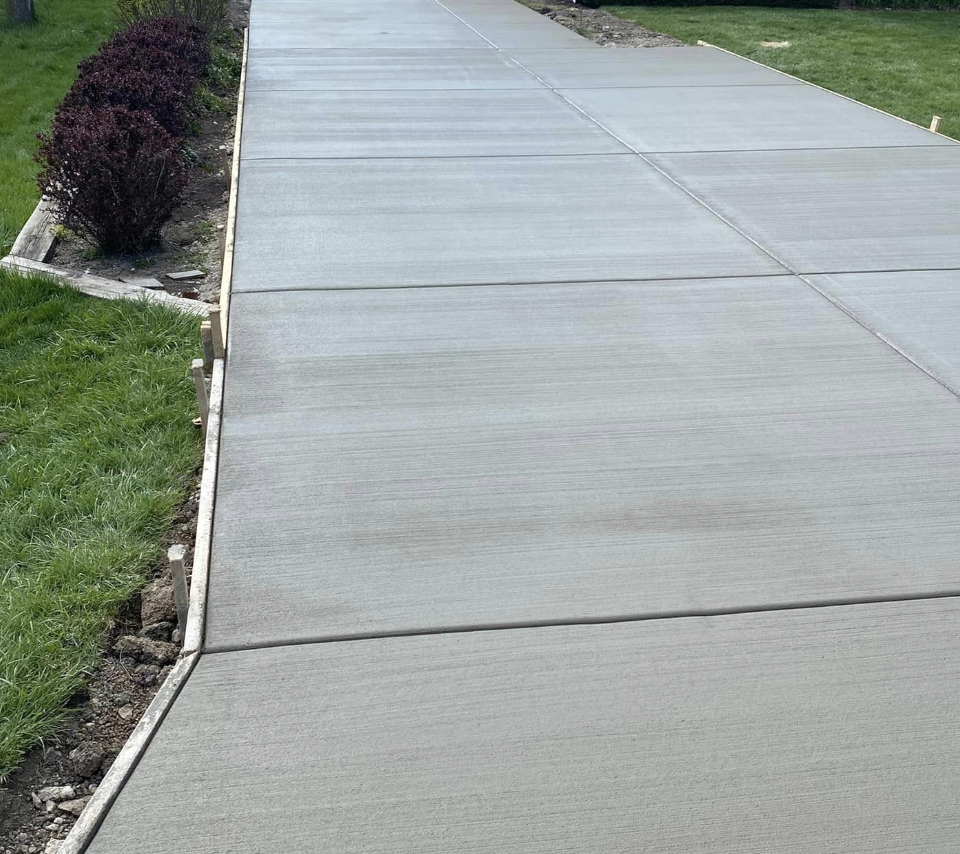
Public sidewalks carry their own thickness table. Where a walk crosses a driveway, the full seven-inch section continues through with expansion joints on both sides, and standard runs outside driveways step down to five inches. The concrete walkways and sidewalkspoured along Warrenville's right-of-way follow those sections exactly.
When Patios and Accessory Slabs Need a Permit
The model residential code exempts small flatwork from permitting. Warrenville struck that exemption from its adopted residential code deliberately, so concrete patios, garden walks, and stoops file at the same flat fee as sidewalk work. Assume every slab on the property needs paperwork here and you will never guess wrong.
Zoning controls placement before the building code says a word. Pavement setbacks run from 3 feet at side and rear lot lines in most residential districts to zero in the densest zones, and paving may cover no more than 50 percent of a required front yard. Those limits shape the drawing before the first form stake.
A slab that lands inside a setback has no cheap fix, because cured concrete does not slide over a foot. The site plan filed with Warrenville's online application shows distances to both lot lines, so the reviewer catches conflicts while they are still on paper. That check costs nothing and prevents the worst mistakes.
Ground Conditions That Shape Concrete Work Here
Gravel Subsoils Along the West Branch
State geologists map Henry Formation outwash along the West Branch DuPage River through Warrenville: sand and gravel with lenses of silt and clay, running up to fifty feet thick where old meltwater channels concentrated it. Ground like that drains fast, compacts predictably, and gives concrete the stable base it wants.
The quarry era proves the point. Cantera sits on 650 acres, roughly one-fifth of Warrenville's land, that operated as a limestone quarry and concrete batch plant from the 1950s to the early 1990s. Nobody runs a quarry for four decades where the rock and gravel are thin or unpredictable.
Away from the river the ground flips to Wadsworth till, a gray, clayey, silty soil that holds water and heaves harder in a deep freeze. Beneath everything sits Silurian dolomite bedrock roughly sixty feet thick. Which soil a Warrenville lot sits on changes the base prep, so the estimate follows the ground.
Frost Depth and Footing Requirements
Warrenville's amended residential code, built on the 2021 edition, sets the local frost line at 42 inches and rates weathering severe. Any structural footing, a stoop or stair foundation for instance, must reach from grade down to that full depth. Flatwork floats above the frost line rather than fighting it.
Floating is only safe when the base drains. A concrete slab over open-graded stone sheds water before a freeze can turn it into a lifting wedge, while a slab over trapped water rides up each winter and settles back cracked. Base preparation decides how driveways age on Warrenville's soils.
The severe weathering rating is also why exterior pours here get air-entrained concrete, mixed so a hard freeze has somewhere to push besides the surface. Joint layout and drainage pitch get drawn before the truck is scheduled. Most winter slab damage starts as a grading decision, not a concrete failure.
Concrete Services Warrenville Homeowners Ask For
Driveway Replacement on Established Streets
Summerlakes went in between 1974 and 1985, and Old Town carries blocks older than that, which puts many original driveways well past their working life. Replacement, not patching, is the steady call across Warrenville's established streets. Once the base under a panel fails, no surface treatment brings it back in this climate.
Zoning shapes the new layout before any concrete arrives. Residential driveways here measure from ten to twenty-four feet wide at the property line, and the front-yard paving cap applies to any widening. The concrete driveways page explains thickness, base depth, and joint spacing choices in plain terms.
On a driveway, broom finish prices between $8 and $12 per square foot across the Naperville area, and most of that spread is demolition and base repair rather than the finish itself. A slab lifted off Warrenville's gravel subsoil costs less to rebuild than one sitting on saturated clay. What sits under the old driveway writes part of the quote.
Stamped and Decorative Finishes for Outdoor Living
Patio and pool-deck calls from Warrenville's newer sections, Cantera's residential blocks included, often ask about decorative finishes. Stamped work carries a real premium over broom finish because color hardener, release agent, and the stamping mats each add a full round of labor. The texture is tooled into wet concrete, never painted on afterward.
The stamped concrete page shows which patterns keep their texture through Warrenville winters and which trap water in deep grout lines. Pattern and color choices move a decorative project within its range more than square footage does. Simple patterns in a single color sit at the bottom.
A sound but tired patio has a cheaper path than tear-out. Overlays and resurfacing extend slab life 10 to 15 years across the Naperville area, and they take stains and saw-cut patterns well. Near the West Branch, a drainage check comes first, since an overlay cannot fix water arriving from next door.
Budgeting: Permit Fees Plus Construction Costs
Warrenville's flat permit fees make honest concrete budgeting possible: add the filing cost to the regional construction range and a realistic bracket takes shape before anyone measures a form board. No fee on the flatwork schedule scales with project size, so a larger pour absorbs its paperwork cost more easily than a small one.
Sample All-In Budgets for Common Projects
Each line below adds Warrenville's current permit fee to the typical construction range for the Naperville area, because that is how the checks actually get written. Ranges reflect typical site conditions, and unusual access or deep base repair moves a project up its range and can push past it.
- •Two-car driveway replacement: the $100 driveway permit plus $3,200 to $5,400 for a standard tear-out and repour across the Naperville area.
- •Mid-size broom-finish patio: the $100 patio permit plus $2,400 to $4,800 depending on size and access.
- •Stamped patio: the $100 permit plus $12 to $22 per square foot of finished decorative concrete.
- •New walkway or front stoop: the $100 patios and sidewalks fee plus footage priced on a written quote.
- •Apron or curb cut in the right-of-way: the driveway figures above plus Warrenville's $400 cash performance bond, and a curb cut also takes its own right-of-way permit with a separately assessed city fee.
Naperville Concrete Construction measures the site, checks the zoning district and the right-of-way line, and files Warrenville's paperwork before scheduling any pour. The written quote states price, scope, and schedule in plain language so nothing rides on a handshake. A text or call to (331) 261-5065 with the street name and a rough project size is enough to get started.
Concrete work in Warrenville, IL runs on the permit calendar, and that calendar favors whoever files first. A spring conversation usually means a summer driveway, while a midsummer application can push a patio toward the edge of pouring season. The concrete never takes as long as the paperwork that precedes it.
Put a Warrenville Pour on the Calendar
Tell us about your project and we'll get back to you within 24 hours.